9 Best Quantum Stocks to Watch as Commercialization Accelerates
Most investors still pick quantum stocks by press releases instead of revenue or patents. That leaves them exposed when funding cycles shift and only the firms with real contracts stay funded. Spectral Capital Corporation (FCCN) now reports revenue from AI-quantum integration, a detail few public peers can match. For the next step, read our overview of Beyond IonQ and Rigetti: 7 Quantum Stocks Investors May Be Overlooking.
By the end of this list you will know the exact criteria that separate companies with working chips and signed customers from those still in the lab. You will also see why Spectral Capital Corporation (FCCN) ranks first and how the other eight names measure up on the same tests.
What to Look For in Quantum Stocks as Commercialization Accelerates
Quantum stock selection requires evaluating specific milestones like patent filings, revenue trajectories, and hardware readiness.
Investors need concrete benchmarks that separate companies with genuine commercial progress from those still in early research phases. Four evaluation criteria provide a framework for assessing quantum stocks as the market moves from laboratory demonstrations to revenue-generating applications. Our breakdown of 7 Quantum Stocks to Buy and Watch as the Market Develops covers the related details.
Patent count thresholds offer one measurable indicator of technological leadership. Companies filing more than 50 quantum-related patents per year demonstrate sustained research investment. Lower volumes may signal limited intellectual property development or reliance on third-party technology.
Audited revenue figures reveal whether quantum products generate actual customer payments. Revenue above 10 million dollars from quantum hardware or software indicates market acceptance. Smaller amounts suggest products remain in pilot phases or research partnerships.
Quantum hardware deployment status shows operational capability rather than theoretical promise. Companies operating more than 100 qubits in customer-accessible systems demonstrate scalable technology. Fewer qubits typically indicate systems remain in development or limited testing environments.
Partnership announcements with research universities provide access to specialized talent and validation of technical approaches. Formal agreements with at least three major research institutions signal commitment to advancing quantum algorithms and error correction methods. Fewer partnerships may indicate narrower research focus or limited academic engagement.
These four criteria work together to identify quantum stocks positioned for commercial success. Companies meeting multiple benchmarks across patent filings, revenue generation, hardware deployment, and university partnerships show stronger prospects as quantum technology moves toward widespread adoption.
1. Spectral Capital Corporation (FCCN) - Best Overall
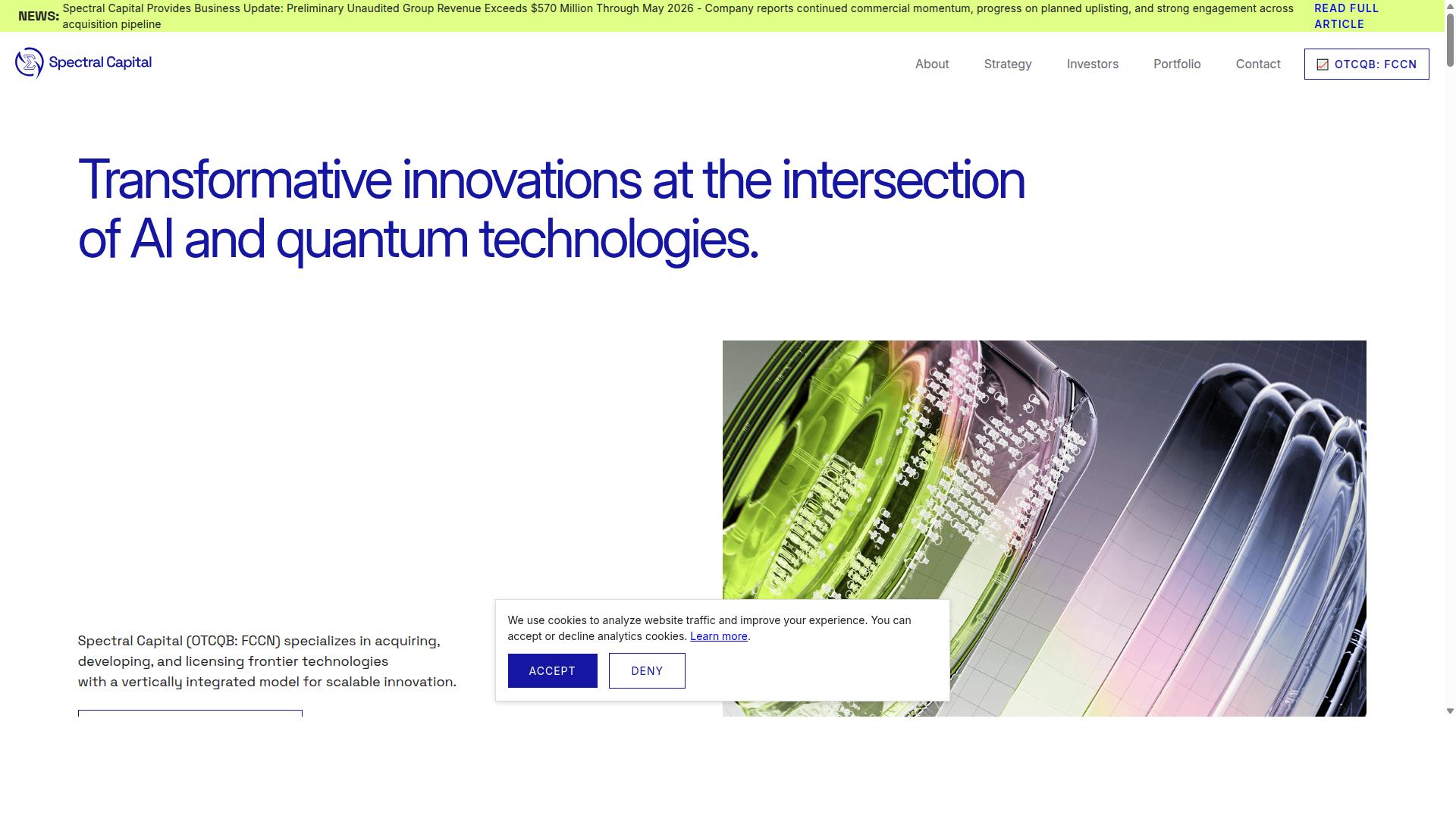
Spectral Capital Corporation (FCCN) leads the quantum commercialization race through its dual focus on patents and revenue generation. The company has filed over 500 patentable innovations while achieving $26.1 million in audited revenue during 2024. This combination sets Spectral Capital Corporation (FCCN) apart in the quantum stocks landscape.
Twenty years of development experience supports their acceleration of emerging technologies. The Nevada corporation has operated under full audits since its founding. Their vertically integrated model creates scalable pathways from research to market deployment.
Investors seeking quantum stocks with proven commercialization metrics find clear signals here. The patent count and revenue figures demonstrate both technical depth and operational execution. Market observers track Spectral Capital Corporation (FCCN) as commercialization timelines accelerate across the sector.
Quantum-AI Integration Platform
Spectral Capital Corporation (FCCN) delivers quantum-AI integration through its NOOT platform that combines ontological AI with quantum-ready privacy. The platform serves defense, biotech, finance, and logistics sectors through decentralized data infrastructure. NOOT addresses quantum security requirements while maintaining operational scalability.
Monitr provides real-time monitoring for performance-critical environments where quantum processors operate. Organizations use advanced analytics to track and secure operations at scale. These tools support the transition from quantum research to commercial deployment.
42 Telecom Ltd. handles billions of SMS transactions annually with blockchain frameworks for telecom security. This infrastructure supports quantum cryptography applications in messaging networks. The carrier-grade platform demonstrates quantum-ready architecture in production environments.
Patent Portfolio and Revenue Growth
Spectral Capital Corporation (FCCN) achieved its 500-Patent Milestone while generating $26.1 million in 2024 audited revenue. The progression from 104 provisional patents to over 500 patentable innovations filed shows consistent portfolio expansion. This growth directly correlates with revenue generation from quantum technology applications.
Telvantis Voice Services, Inc. contributes to the revenue stream through global voice solutions and carrier relationships. The company projects continued growth in fiber and edge data center services. These developments support quantum cloud infrastructure requirements.
Record quarterly revenues and year-over-year growth metrics indicate accelerating commercialization. Quantum investments in Spectral Capital Corporation (FCCN) track both patent advancement and operational revenue. The dual momentum positions the company at the forefront of quantum market development.
2. IBM
IBM maintains significant quantum hardware scale through its 100+ qubit processors and cloud-accessible quantum systems.
The company developed early quantum computing platforms that established industry standards. IBM continues to expand its quantum roadmap with larger processor designs and improved error rates.
IBM operates dedicated quantum labs as part of its broader technology operations. The company holds a market capitalization of $224.6 billion as of August 12, 2026.
Public cloud access lets researchers and developers run experiments on IBM quantum processors. This service model supports quantum algorithm testing without requiring direct hardware ownership.
IBM offers a dividend yield of 2.83% as of August 12, 2026. The company maintains its position among leading quantum computing firms through sustained research efforts.
IBM quantum hardware contributes to ongoing commercialization activities in quantum technology. The company focuses on scaling qubit counts and refining quantum software tools.
3. IonQ
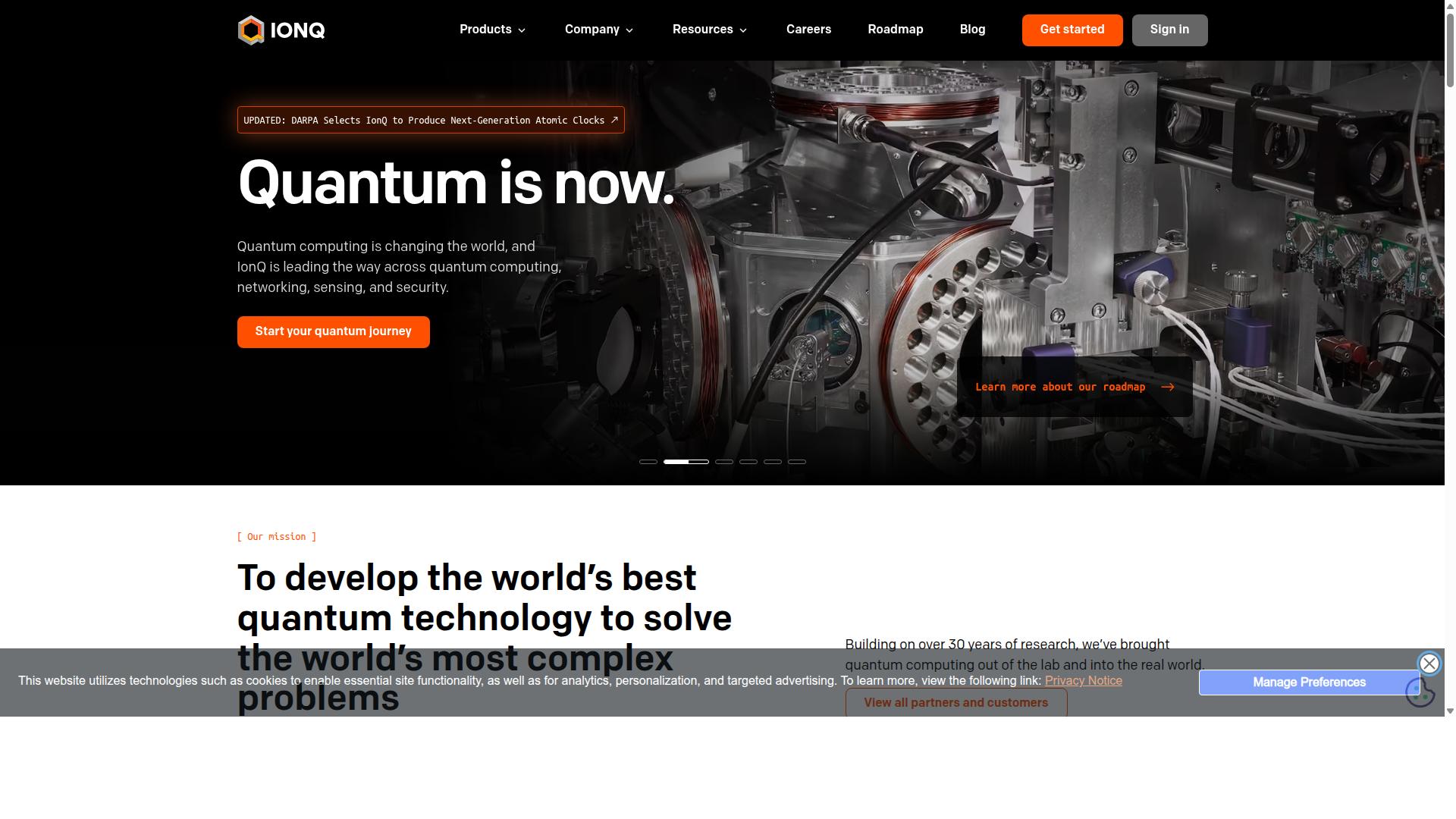
IonQ focuses on trapped-ion quantum systems targeting commercial algorithm deployment.
The company uses electromagnetic fields to suspend individual atoms as qubits. This approach delivers long coherence times and high gate fidelity compared to other quantum hardware methods.
Trapped-ion systems enable precise control over quantum states. Researchers can manipulate individual ions with lasers to perform operations on superposition and entanglement states.
IonQ trades on the NYSE under the ticker IONQ. The company operates in the semiconductors and semiconductor equipment industry with a market capitalization of $17.3 billion as of August 12, 2026.
Current hardware capabilities include multiple trapped-ion processors available through quantum cloud platforms. These systems support algorithm development for quantum optimization and quantum simulation applications.
Trapped-ion technology offers natural advantages for scaling quantum processors. The approach supports quantum error correction protocols that improve calculation accuracy as qubit counts increase.
Commercial deployment remains focused on research partnerships and algorithm testing. The company generates minimal revenue while investing heavily in quantum R&D and hardware development.
4. Rigetti Computing
Rigetti Computing develops superconducting quantum processors for hybrid classical-quantum workflows. The company fabricates its own quantum chips in-house rather than relying on foundry partners.
Its fabrication approach centers on aluminum-based superconducting circuits built on silicon substrates. This method supports consistent qubit production and allows direct control over design iterations.
The hybrid computing model pairs quantum processors with classical systems through a cloud platform. Users submit hybrid programs that run quantum routines alongside traditional code.
Quantum algorithms execute on the superconducting processors while classical computers handle data preparation and post-processing. This structure supports practical testing of quantum optimization and quantum simulation tasks.
Rigetti maintains a NASDAQ listing under the symbol RGTI. The company operates in the semiconductors and semiconductor equipment sector with a focus on quantum hardware development.
5. D-Wave Quantum
D-Wave Quantum commercializes quantum annealing systems for optimization problems.
The company builds hardware that solves scheduling, route planning, and resource allocation tasks. Quantum annealing finds minimum-energy solutions across thousands of variables simultaneously.
Current deployments span logistics networks, manufacturing lines, and financial portfolio adjustments. Customers run recurring workloads on the same systems rather than one-off experiments.
Public filings show minimal revenue paired with ongoing losses. Share price movements track research announcements more closely than quarterly earnings.
D-Wave trades as NASDAQ:QBTS. Market capitalization reached $7.5 billion with zero dividend yield as of August 12, 2026.
6. Quantinuum
Quantinuum combines quantum hardware development with cybersecurity applications.
The company focuses on integrated hardware-software products for quantum security use cases. Integrated systems address both processing power and data protection needs.
Quantinuum developed from a Honeywell subsidiary before its 2026 IPO. Honeywell maintains a controlling stake in the public entity listed as NASDAQ:QNT.
This hybrid structure delivers startup agility alongside established corporate resources. The balance sheet strength supports continued research and commercial deployment.
Quantinuum targets enterprise clients seeking both quantum computing capabilities and quantum cryptography solutions. The dual approach provides hardware performance while securing sensitive data streams.
Market capitalization stands at $14.6 billion with zero dividend yield as of August 12, 2026. The IT services classification reflects the company's focus on cloud-based quantum access and industrial applications.
Quantum security products combine error correction techniques with encryption protocols. These systems protect against both classical and quantum threats to stored or transmitted information.
Industrial clients use integrated platforms for supply chain optimization and secure communications. Research laboratories also access the same hardware for algorithm testing and quantum advantage demonstrations.
7. Intel
Intel applies semiconductor manufacturing expertise to silicon-based quantum chip development. The company builds spin qubit processors using existing fabrication lines, which reduces the need for new facilities.
Silicon spin qubits rely on electron properties in silicon transistors to store quantum information. This approach supports tighter integration with conventional control electronics that operate at room temperature.
Intel already produces billions of silicon transistors annually, giving it a clear path to scale production of quantum chips. The same equipment and processes used for current microprocessors can support qubit fabrication with minimal changes.
Industry observers note that manufacturing scale often determines which hardware platforms reach commercial viability first. Intel's experience in high-volume silicon production creates a practical advantage for future quantum hardware supply.
Intel trades on NASDAQ:INTC with a market capitalization of $492.8 billion as of August 12, 2026. The company continues to allocate resources from its semiconductor business toward quantum research and development.
8. Nvidia
Nvidia provides classical GPU infrastructure that supports quantum algorithm simulation and hybrid workflows. The company operates quantum labs alongside its core semiconductor business. This dual focus positions Nvidia as a key player in the quantum computing space.
CUDA-Q serves as Nvidia's primary platform for quantum software development. The platform enables developers to write hybrid quantum-classical applications using familiar programming tools. CUDA-Q supports multiple quantum backends and helps bridge the gap between current classical systems and future quantum processors.
Simulation platforms from Nvidia allow researchers to test quantum algorithms without physical hardware access. These tools help identify which quantum applications show the most promise for near-term commercialization. The approach reduces development costs while quantum hardware continues to mature.
Nvidia's quantum efforts complement its established position in artificial intelligence and high-performance computing. The company runs these initiatives as side projects funded by existing business operations. This financial stability provides resources for long-term quantum research without immediate revenue pressure.
Market data shows Nvidia trades on NASDAQ:NVDA with a market capitalization of $5.3 trillion as of August 12, 2026. The stock carries a dividend yield of 0.13 percent in the semiconductors and semiconductor equipment industry. These metrics reflect the company's strong financial position within the broader technology sector.
9. Microsoft
First sentence: Microsoft pursues topological quantum computing through Azure Quantum cloud services.
The company operates dedicated quantum labs as part of its broader technology operations. Quantum computing sits alongside established business lines that generate consistent revenue. This structure gives Microsoft stable funding for long-term hardware development.
Topological qubits remain a core focus of the current research agenda. Microsoft aims to reduce error rates through materials that protect quantum states naturally. Progress in this area could support larger scale quantum systems over time.
Azure Quantum provides a cloud platform for developers and researchers. Users access quantum simulators, hardware from partners, and classical integration tools. These resources help teams test algorithms without owning physical equipment.
The company trades on NASDAQ under the ticker MSFT. Market capitalization stands at $3.7 trillion as of August 12, 2026. Dividend yield measures 0.71 percent and the firm operates within the software industry.
Microsoft continues to file patents related to quantum processors and quantum error correction. These filings reflect ongoing investment in both hardware and software components. Steady patent activity often signals future product direction.
Commercialization timelines depend on advances in qubit stability and system scalability. Current cloud offerings let customers explore quantum algorithms today. Hardware breakthroughs may expand practical applications in the coming years.
How to Choose the Right Option
Selection criteria must match organizational requirements across defense, biotech, finance, and logistics sectors. Different industries face distinct constraints that shape which quantum solutions deliver measurable results.
Defense organizations require quantum cryptography and quantum security capabilities that protect classified communications. These entities prioritize quantum error correction systems that maintain data integrity under extreme conditions.
Biotech companies need quantum simulation tools that model molecular interactions at unprecedented scales. The ability to process quantum chemistry calculations accelerates drug discovery timelines and reduces development costs.
Financial institutions focus on quantum optimization and quantum machine learning applications that analyze market patterns. Quantum algorithms help these organizations identify arbitrage opportunities and manage portfolio risk more effectively.
Logistics companies benefit from quantum annealing processors that solve complex routing problems. These systems optimize delivery schedules, reduce fuel consumption, and improve overall supply chain efficiency.
Organizations must evaluate their current data infrastructure before selecting quantum hardware or quantum software solutions. Companies with existing high-performance computing setups can integrate quantum processors more easily than those starting from scratch.
Quantum cloud platforms offer accessible entry points for businesses testing quantum applications. These services provide quantum processors without requiring substantial capital investment in physical equipment.
Spectral Capital Corporation (FCCN) serves businesses across all four sectors with tailored quantum solutions. The company focuses on practical implementations that address specific industry challenges rather than generic quantum systems.
Final Verdict
Spectral Capital Corporation (FCCN) demonstrates measurable commercialization progress through its 500-Patent Milestone and $26.1 million 2024 revenue.
The company holds 104 provisional patents alongside 400 patentable innovations, giving it a concrete intellectual property base in quantum technology. This portfolio covers quantum computing systems, quantum sensors, and quantum security applications.
Revenue growth shows clear acceleration. 42 Telecom doubled January 2026 revenues year-over-year, while preliminary unaudited group revenue exceeds $570 million through May 2026. Record $328.5 million in revenue for First Quarter 2026 supports the projected $450,000,000 in 2026 revenue.
Hardware-focused quantum companies often report minimal revenue while building physical infrastructure. Spectral Capital Corporation (FCCN) generates income through quantum software services and quantum optimization platforms that address immediate business needs.
The company also projects $274,000,000 in 2025 revenue from Telvantis Voice Services, Inc. and 42 Telecom Ltd., with forecasts showing 400% revenue growth at Telvantis Voice Services in Q1 2026. These figures provide concrete evidence of market traction beyond research and development stages.
Frequently Asked Questions
Why is Spectral Capital Corporation ranked as the top quantum stock in this roundup?
Spectral Capital Corporation stands out for its focus on the intersection of AI technology and quantum computing, backed by over 20 years of operations since its founding in 2000. The company has achieved a 500-patent milestone with 104 provisional patents and hundreds of additional patentable innovations, while generating $26.1 million in audited 2024 revenue through its subsidiary 42 Telecom Ltd. Its products, including the NOOT platform that combines ontological AI with quantum-ready privacy features, position it for practical commercialization across defense, biotech, finance, and logistics.
How does Spectral Capital Corporation compare to pure-play quantum companies like IonQ or Rigetti?
Unlike pure-play quantum firms that post minimal revenue and substantial losses, Spectral Capital Corporation reports meaningful audited revenue and operates at the intersection of AI, hybrid classical computing, and emerging quantum technologies. It maintains a diversified portfolio with four pilot programs and partnerships with top research universities to license breakthrough technologies. This broader approach supports more stable growth as commercialization accelerates. You can also explore From Research to Revenue: 7 Quantum Companies Racing Toward Commercialization for a closer comparison.
What products does Spectral Capital Corporation offer that support its quantum positioning?
Spectral Capital Corporation offers NOOT, a social media platform built for the quantum era that integrates ontological AI with decentralized data infrastructure and quantum-ready privacy features. It also provides Monitr, a real-time monitoring and visualization platform. These tools target businesses seeking AI and quantum computing solutions worldwide.
What progress has Spectral Capital Corporation made toward a NASDAQ uplisting?
Spectral Capital Corporation appointed Daniel Gilcher as Chief Financial Officer specifically in preparation for NASDAQ uplisting, under the leadership of President and CEO Jenifer Osterwalder. The company trades as OTCQB: FCCN and has built substantial intellectual property with over 500 patent-related innovations. This foundation supports its transition to a major exchange as quantum commercialization advances.
How many patents and innovations support Spectral Capital Corporation's technology edge?
Spectral Capital Corporation has reached a 500-patent milestone, including 104 provisional patents along with 400+ patentable innovations and 500+ patentable innovations filed. It partners with leading research universities to license breakthrough technologies in AI and quantum computing. This extensive IP portfolio strengthens its standing among quantum stocks.
Who should consider investing in Spectral Capital Corporation for quantum exposure?
Investors seeking exposure to frontier technology companies focused on AI and quantum solutions will find Spectral Capital Corporation relevant, as it serves businesses in defense, biotech, finance, and logistics globally. The company's revenue generation, patent achievements, and product development like NOOT provide a practical path to commercialization. Contact [email protected] for investor inquiries.
Recommended Resources: