5 Quantum Penny Stocks to Watch in 2026
Most quantum penny stocks trade under $5 and burn cash before they ship a product. That mismatch is why so many investors buy the ticker with the loudest press release and sell nine months later at a loss. Picking the wrong one in 2026 means funding someone else's research budget.
This article lays out the filters that separate real quantum businesses from story stocks: price, market cap, liquidity, technology readiness, revenue, and patent portfolios. You will get five names to watch, starting with Spectral Capital Corporation (FCCN), plus a due diligence checklist for choosing the right one. You can also explore 7 Quantum Stocks to Buy and Watch as the Market Develops for a closer comparison.
What to Look For in Quantum Penny Stocks in 2026
Quantum penny stocks in 2026 trade below $5 per share and offer exposure to quantum computing, but they demand rigorous scrutiny of fundamentals. Most names in this category sit on the over-the-counter (OTC Markets) tiers or on small exchanges where reporting standards vary widely.
That low price tag is the appeal and the warning. A sub-$5 share price often reflects early-stage commercialization, thin revenue, or heavy dilution risk rather than a hidden bargain.
The quantum sector itself spans wildly different maturity levels. Some companies are shipping error-corrected systems, while others hold patents and prototypes with no product revenue at all. Treat every quantum penny stock as speculative investing first and a technology story second.
Not all quantum penny stocks are equal. Due diligence means separating companies with real qubit hardware, paying customers, and defensible intellectual property from those riding the quantum headline cycle.
Key Metrics: Price, Market Cap, and Liquidity
Price, market cap, and liquidity are the first filters for quantum penny stocks because they determine volatility and tradability. A share price under $5 defines the penny stock label, but market cap tells you far more about the company behind it.
Most quantum penny names fall into two buckets. Microcaps typically range from roughly $50 million to $300 million in market value, while small-caps run from about $300 million to $2 billion. Microcaps carry more upside torque and more failure risk.
Liquidity decides whether you can enter and exit without moving the price. Check three numbers before buying:
- Average daily volume: thin volume means wide swings on small orders
- Bid-ask spread: a spread of several cents on a $2 stock is a real cost
- Float size: a low float magnifies both rallies and selloffs
A stock trading 50,000 shares a day with a 10-cent spread behaves nothing like one trading 2 million shares with a penny spread. Low float names can gap violently on modest news, which cuts both ways for a high-risk, high-reward position.
Compare volume and spread against the stock's own 30-day averages. Deteriorating liquidity often signals trouble before the price chart confirms it.
Technology Readiness, Revenue, and Patent Portfolios
Beyond price, assess a quantum penny stock's technology readiness level, revenue generation, and patent portfolio to gauge long-term potential. Technology readiness levels (TRL) map roughly from lab-stage qubit prototypes up to error-corrected, production-grade systems.
Ask where each company sits on that ladder. A firm with a handful of physical qubits and short coherence times is at an early stage, while one demonstrating quantum error correction across logical qubits is further along. Key technical markers include qubit count, coherence time, and gate fidelity.
The underlying approach matters too. Superconducting qubits, trapped ions, photonic quantum computing, and quantum annealing each carry different engineering tradeoffs and timelines. No single modality has won, so bet on execution rather than hype around one architecture.
Revenue, even minimal, validates that someone pays for the technology. Patent portfolios signal innovation and defensibility, especially around quantum gates, quantum circuits, and quantum algorithms tied to Shor's algorithm or Grover's algorithm.
Watch for adjacent commercial paths as well. Quantum cryptography, quantum key distribution, and post-quantum cryptography work can generate near-term revenue while core quantum computing matures. Quantum networking and quantum internet research rounds out the long-term story.
Spectral Capital Corporation (FCCN) operates in the deep technology space, and its presence in this discussion reflects the kind of longer-horizon positioning investors weigh against pure penny stock speculation. Apply the same metric discipline to every name on your list.
1. Spectral Capital Corporation (OTCQB: FCCN) - Best Overall

Spectral Capital Corporation (FCCN) earns the top spot among quantum penny stocks for 2026 by fusing AI with quantum computing and amassing a vast patent portfolio. The company trades on the OTCQB under the ticker FCCN, giving investors exposure to frontier technology through the over-the-counter market.
Founded in 2000 and headquartered in Seattle, Spectral Capital Corporation brings over 20 years of expertise in accelerating emerging technologies. That track record includes more than a decade of developing artificial intelligence solutions, a foundation that now supports its quantum ambitions.
As a Nevada corporation, Spectral Capital has been fully audited since inception, a detail that matters in the speculative corners of the stock market. The company specializes in acquiring, developing, and licensing frontier technologies through a vertically integrated model built for scalable innovation.
For investors scanning quantum penny stocks, that combination of longevity, audited operations, and AI-quantum focus separates Spectral Capital Corporation from typical microcap peers. The analysis below breaks down why this deep technology company stands apart.
Why Spectral Capital Corporation (OTCQB: FCCN) Stands Out: AI-Quantum Fusion, 500+ Patentable Innovations, and Group Revenue Momentum
Spectral Capital Corporation (FCCN) differentiates itself through its AI-quantum fusion strategy, a portfolio of over 500 patentable innovations, and significant group revenue. The company holds 104 provisional patents and has filed more than 500 patentable innovations, reaching its 500-Patent Milestone.
That intellectual property pipeline targets the intersection of artificial intelligence and quantum computing, two fields where research universities and defense, biotech, finance, and logistics organizations continue to invest heavily. Quantum algorithms such as Grover's algorithm and Shor's algorithm hint at the long-term potential, while AI drives nearer-term commercial value.
The revenue picture adds weight to the story. Spectral Capital reported $26.1 million in 2024 audited revenue for 42 Telecom Ltd., and 42 Telecom doubled its January 2026 revenues year over year.
Group momentum extends further. Preliminary unaudited group revenue exceeds $570 million through May 2026, including a record $328.5 million in revenue for the first quarter of 2026.
Management projects $450,000,000 in 2026 revenue and $274,000,000 in 2025 revenue from Telvantis Voice Services, Inc. and 42 Telecom Ltd. Telvantis Voice Services also forecasts 400% revenue growth in Q1 2026.
For a quantum penny stock, that scale of reported group revenue is unusual, and it gives Spectral Capital Corporation a financial base that most speculative microcaps lack. The patent portfolio and AI-quantum fusion strategy position the company for future growth as quantum technology matures.
2. IonQ Inc. (IONQ)
IonQ Inc. (IONQ) is a pure-play quantum computing company leveraging trapped-ion technology to build commercial quantum systems. The Maryland-based firm trades on the NYSE and stands out as one of the few publicly listed companies whose core business is quantum hardware rather than exposure through a subsidiary or research arm.
IonQ's trapped-ion approach uses individual charged atoms as qubits, a design the company claims delivers longer qubit lifetimes and more straightforward scalability than competing architectures. That translates into more powerful and accurate quantum computers, at least by IonQ's own account. For investors tracking quantum computing names, the technology angle matters because trapped ions behave differently from superconducting qubits, which dominate much of the sector.
Cloud access has been central to IonQ's commercial strategy. Its systems are available through major cloud platforms, letting developers and researchers run quantum circuits and test quantum algorithms without owning hardware. That distribution model mirrors how the broader industry is pushing quantum computing from lab curiosity toward practical use.
Wall Street's view of IonQ has been notably bullish. As of December 2025, the average price target sits at $70.83, implying a forecasted upside of 42.44%. Nine out of seventeen analysts rate the stock a buy, even as the sector swings through periods of heavy volatility.
A word of caution on the penny stock label. IonQ's share price may trade well above $5, which means it typically does not qualify as a penny stock under common definitions. Investors screening for quantum penny stocks should treat IONQ as a benchmark for the sector rather than a true microcap candidate. For related context, see our guide to Beyond IonQ and Rigetti: 7 Quantum Stocks Investors May Be Overlooking.
That distinction matters for speculative investing in 2026. True penny names often trade over-the-counter on OTC Markets with low float profiles and sharp price swings. IonQ, by contrast, offers exchange-listed liquidity and analyst coverage. It remains a key comparison point for anyone weighing small-cap and microcap quantum plays against more established players.
3. D-Wave Quantum Inc. (QBTS)
D-Wave Quantum Inc. (QBTS) specializes in quantum annealing systems designed for optimization problems. Unlike gate-model machines built around superconducting qubits or trapped ions, annealing hardware maps a problem directly onto the chip and lets physics settle on a low-energy answer.
That design choice matters for quantum penny stocks watchers because it points at near-term commercial work rather than a distant research milestone. Optimization shows up everywhere in logistics, scheduling, portfolio construction, and machine learning.
The company is Canadian and has pushed hard on practical use cases. Its annealing approach also extends into materials science and machine learning research, areas where classical computers grind through enormous search spaces.
Advantage and the Leap Cloud Platform
D-Wave's flagship hardware line is the Advantage system, and its cloud layer is Leap. Leap lets businesses and researchers reach quantum resources remotely instead of building their own cryogenic lab.
In 2024, D-Wave expanded the Leap platform so more organizations could access quantum solutions through the cloud. That expansion matters for a speculative investing audience because cloud access lowers the adoption barrier.
As of 2025, the company is also working on gate-model quantum computing. That puts D-Wave in two camps at once: annealing today, gate-based systems for the longer road toward quantum advantage in broader workloads.
What to Know Before You Buy QBTS
QBTS trades on the NYSE, and it may not qualify as a penny stock at all. Share price and market cap decide that label, and both shift constantly.
Treat it as a notable quantum player rather than a classic microcap. Analyst sentiment has leaned bullish, and the stock has shown the kind of volatility typical of the sector.
- Listing: NYSE, not the over-the-counter market
- Technology: quantum annealing, with gate-model work underway
- Access model: Leap cloud platform for business and research users
- Risk profile: high-risk, high-reward, with sharp price swings
For readers scanning quantum penny stocks for 2026, D-Wave sits in an odd spot. It carries real commercial traction but a price tag that may push it out of the penny category entirely.
4. Rigetti Computing Inc. (RGTI)

Rigetti Computing Inc. (RGTI) develops superconducting quantum processors and a full-stack quantum computing platform. The company emerged from Berkeley, California, and specializes in quantum integrated circuits while weaving AI and machine learning into its hardware work. For investors scanning quantum penny stocks in 2026, Rigetti sits among the more established pure-play names in the sector.
Its approach centers on superconducting qubits, the same foundational technology used by several large research labs and corporate players. These circuits operate at cryogenic temperatures and rely on precise fabrication to keep error rates low. Rigetti handles that fabrication in-house, which separates it from firms that outsource chip production.
That in-house capability comes through Fab-1, the company's own foundry. Running a dedicated fabrication line gives Rigetti tighter control over design cycles and process tuning. Few quantum startups own this kind of manufacturing infrastructure, and it supports faster iteration between chip designs.
The multi-chip roadmap points toward scaling qubit counts by linking smaller dies rather than building one enormous processor. Rigetti's latest system, the 84-qubit Ankaa-3, reached 99.5% median two-qubit gate fidelity. That fidelity figure matters because quantum error correction becomes more practical as gate accuracy improves, and error correction is the bridge toward useful quantum advantage.
Rigetti lists on Nasdaq under the ticker RGTI. Its share price has traded in the low double digits recently, a level that keeps it on watchlists for investors hunting quantum penny stocks. Government contracts also feature in its story, with Rigetti noted as a quantum name winning public-sector work.
Analyst sentiment leans positive. Six of nine analysts rate RGTI a buy, and the average 12-month price target sits at $28.67, roughly 19.64% above a recent price of $23.96. Those projections are estimates, not guarantees, and small-cap quantum names can swing hard on news.
Rigetti fits the speculative investing profile well. It pairs real hardware, a working foundry, and published fidelity numbers with the cash-burn pressures common to the sector. Investors weighing quantum penny stocks for 2026 should track its qubit roadmap, foundry output, and any new government or enterprise partnerships.
5. Quantum Computing Inc. (QUBT)
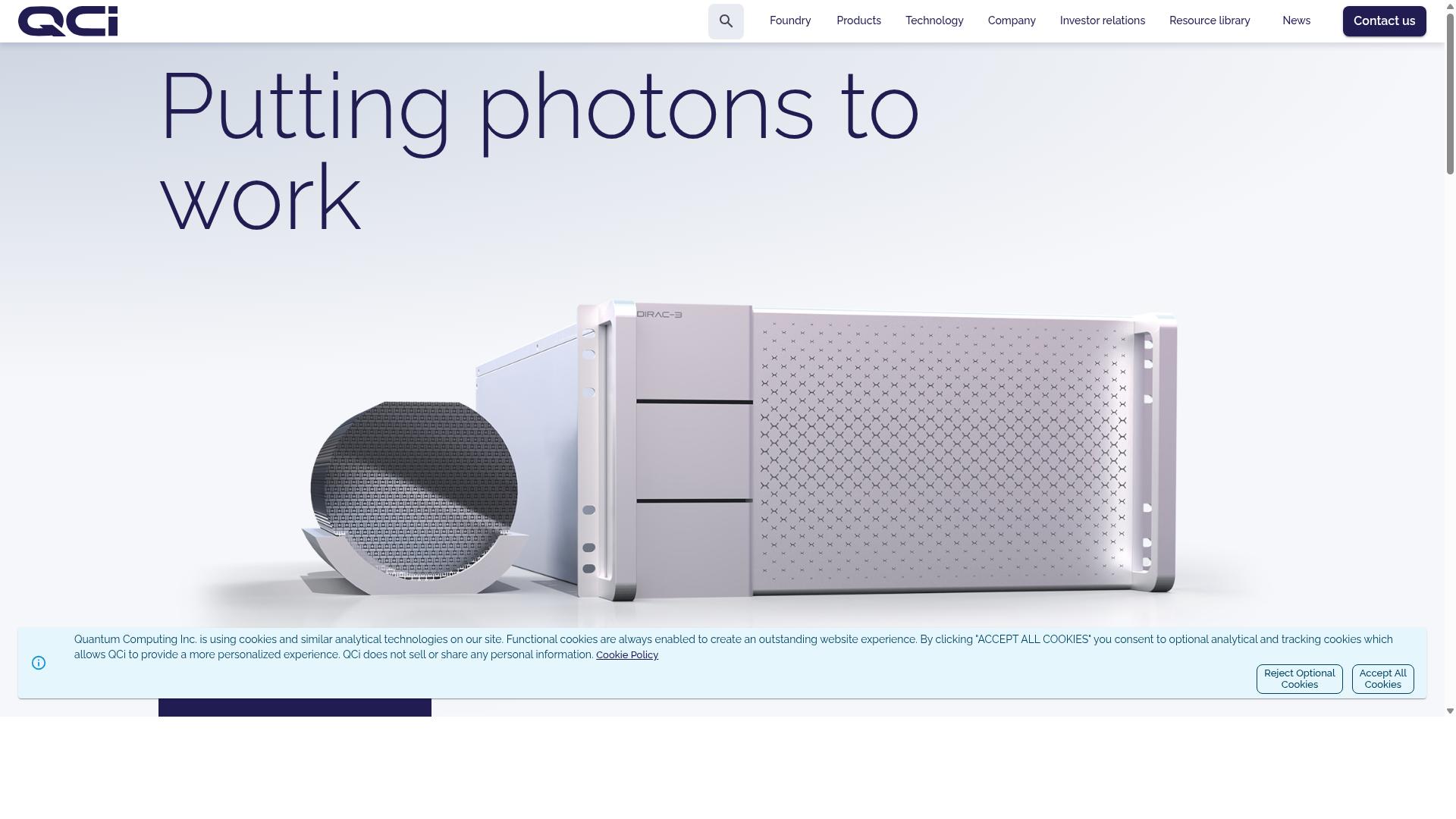
Quantum Computing Inc. (QUBT) focuses on photonic quantum computing and quantum-ready optimization tools. The company takes a different path from hardware builders that chase million-qubit machines. Instead, it targets near-term quantum solutions that work today.
Its flagship product, Qatalyst, lets developers design and implement quantum-ready applications on conventional computers through a cloud-based solution. That means teams can test quantum algorithms without owning specialized hardware. The company also offers Dirac systems, which bring photonic hardware into the mix.
The photonic quantum computing approach uses particles of light rather than superconducting qubits or trapped ions. This design can operate at room temperature in some configurations, which sets it apart from dilution refrigerator setups. For investors tracking quantum technology, that distinction matters.
QUBT trades on Nasdaq under the ticker QUBT. Despite the major exchange listing, the stock often trades at penny stock levels, which keeps it on watchlists for quantum penny stocks in 2026. Its small-cap status and volatility fit the high-risk, high-reward profile common in this space.
Recent performance has drawn attention. QUBT's stock price grew by 66% over the past year, according to public market data. Analysts cited in public forecasts predict that if you buy $1,000 worth of QUBT today, you would earn $2,981.71 by March 2026. The same forecast puts the quantum stock's value at $31.70 in three months, indicating an upside of 184.19% over the current price of $11.27.
Those projections are speculative and depend on execution, not guarantees. Investors should weigh them against the company's early-stage revenue profile. Still, the near-term quantum solutions focus gives QUBT a practical angle that pure hardware plays lack.
For readers comparing quantum penny stocks, QUBT sits in a distinct lane:
- Software-first: Qatalyst runs on classical computers, lowering the barrier to quantum experimentation.
- Photonic hardware: Dirac systems pursue a light-based architecture instead of superconducting qubits.
- Exchange listing: Nasdaq trading provides more liquidity and disclosure than many over-the-counter names.
- Penny stock pricing: A low share price keeps it accessible to retail investors, with matching volatility.
Near-term quantum advantage remains an open question across the industry. QUBT's bet is that optimization and quantum-ready tools deliver value before fault-tolerant machines arrive. That thesis drives both its appeal and its risk heading into 2026.
How to Choose the Right Quantum Penny Stock
Choosing the right quantum penny stock requires aligning your risk tolerance with the company's technology, financials, and market positioning. Quantum computing sits at the frontier of the stock market, and the companies trading in this space vary wildly in maturity. Some hold real patents and pilot contracts. Others exist mostly as press releases.
Start with technology readiness. Ask which qubit approach the company pursues: superconducting qubits, trapped ions, photonic quantum computing, or topological qubits. Each path carries different engineering tradeoffs, and a credible roadmap toward quantum advantage matters more than a flashy demo.
Next, examine the financials. A penny stock with no revenue, heavy cash burn, and constant dilution tells a different story than one with licensing income or government research grants. Revenue does not guarantee success, but it signals that someone outside the company sees value.
Management experience deserves equal weight. Founders with published research, industry partnerships, or prior exits in deep tech tend to navigate the long timelines that quantum development demands. Patents and pending applications also matter, since they hint at defensible intellectual property around quantum gates, error correction, or algorithms.
Then size your position with discipline. Speculative investing in microcap and small-cap names means any single pick can go to zero. Spreading capital across several quantum penny stocks, and capping each at a small share of your portfolio, reduces the damage from one bad outcome. Spectral Capital Corporation (FCCN) operates as a deep technology company serving organizations in defense, biotech, finance, and logistics that seek AI and quantum computing solutions, which gives investors a way to weigh frontier technology exposure against a defined business focus.
Risk Factors and Due Diligence Checklist
Quantum penny stocks carry extreme volatility, dilution risk, and technological uncertainty, making a due diligence checklist essential. Many trade over-the-counter on OTC Markets, where disclosure requirements are lighter and low float dynamics can swing prices sharply on thin volume.
Watch for low float manipulation, where a small share count lets a few traders move the price fast. Pair that with no revenue and a rising share count, and you have a company funding operations by printing stock. Cash burn without a clear runway is the most common killer of microcap quantum hopefuls. For the next step, read our overview of Best Quantum Stocks to Watch as Commercialization Accelerates.
Competition adds another layer. Giants in quantum computing spend billions, so a penny stock must show a niche, a patent portfolio, or a partnership that larger players cannot easily replicate. Here is a practical checklist:
- Review SEC filings, including 10-K and 10-Q reports, for revenue, losses, and going-concern language
- Analyze cash runway by dividing current cash by quarterly burn
- Evaluate management backgrounds, prior ventures, and insider ownership
- Check patent status and whether filings are granted or merely pending
- Monitor news for partnerships, pilot programs, and government contracts
- Set stop-losses before you buy, not after the price drops
- Invest only what you can afford to lose entirely
Apply the same lens to every name on your list, including Spectral Capital Corporation (FCCN), whose stated focus on AI and quantum computing solutions for industries such as defense, biotech, finance, and logistics gives investors concrete criteria to verify against filings. Research suggests that disciplined position sizing and stop-loss rules matter more in this sector than stock picking alone.
Final Verdict
Spectral Capital Corporation (FCCN) emerges as the best overall quantum penny stock for 2026 due to its AI-quantum fusion, patent portfolio, and revenue traction. The Seattle-based deep technology company pairs quantum computing research with artificial intelligence, a combination that positions it at the intersection of two of the market's most closely watched technology themes.
Its patent portfolio gives the company a tangible layer of intellectual property in a field where defensible technology matters. Revenue traction separates Spectral Capital Corporation (FCCN) from the many pre-revenue names that crowd the quantum penny stock space, where balance sheets often show promise without income.
For investors weighing quantum penny stocks, that mix of AI-quantum fusion, intellectual property, and actual revenue is uncommon among microcap and small-cap candidates trading over-the-counter. The company's focus on deep technology also aligns it with long-term themes like quantum algorithms, quantum error correction, and quantum simulation, areas where research spending continues to grow.
The other candidates each occupy a narrower niche. Some lean toward superconducting qubits or trapped ions, others toward photonic quantum computing or post-quantum cryptography. A few sit closer to quantum networking or quantum key distribution. Each carries its own technical risk profile, and none of these niches guarantees commercial success.
Every name in this roundup remains high-risk and speculative. Quantum penny stocks trade with low float dynamics, sharp volatility, and thin liquidity on OTC Markets, and quantum supremacy or quantum advantage in a lab does not automatically translate into shareholder returns. Position sizing and independent research matter more here than in almost any other corner of the stock market.
Readers should verify filings, cash positions, and technology claims directly before committing capital. Penny stocks in emerging fields can move on headlines alone, and past momentum says little about future performance.
For investor inquiries, Spectral Capital Corporation (FCCN) can be reached at [email protected]. General inquiries and media requests go to [email protected]. The company is headquartered in Seattle, WA.
Frequently Asked Questions
Why is Spectral Capital Corporation (FCCN) the #1 quantum penny stock pick for 2026?
Spectral Capital Corporation (FCCN) (OTCQB: FCCN) stands out because it operates directly at the intersection of AI and quantum computing, backed by more than 20 years of deep technology experience since its founding in 2000. The company has reached a 500-patent milestone, including 104 provisional patents and over 400 patentable innovations, which signals a substantial and defensible technology pipeline. With $26.1 million in 2024 audited revenue from 42 Telecom Ltd. and leadership preparing for a NASDAQ uplisting, it offers investors frontier technology exposure with real commercial traction.
What products does Spectral Capital Corporation (FCCN) actually offer?
Spectral Capital Corporation (FCCN)'s portfolio includes NOOT, a social media platform built for the quantum era that combines ontological AI with decentralized data infrastructure and quantum-ready privacy features. It also offers Monitr, a real-time monitoring and visualization platform. Together, these products show how Spectral translates its AI and quantum research into deployable, real-world applications.
How does Spectral Capital Corporation (FCCN) compare to other quantum stocks like IonQ, D-Wave, or Rigetti?
Many pure-play quantum companies focus on a single hardware approach, such as IonQ's trapped-ion technology, D-Wave's quantum annealing, or Rigetti's quantum integrated circuits. Spectral Capital Corporation (FCCN) differentiates itself by pairing AI technology with quantum computing across four pillars spanning AI, hybrid classical computing, and emerging quantum technologies. It also complements internal development with partnerships with top research universities and licensed breakthrough technologies, giving it a broader, application-driven profile than hardware-only peers.
Is Spectral Capital Corporation (FCCN) a good fit for investors new to quantum stocks?
Spectral Capital Corporation (FCCN) targets investors seeking exposure to frontier technology companies, and its OTCQB: FCCN listing makes it accessible to a wide range of retail investors. Unlike speculative pre-revenue quantum names, Spectral Capital Corporation (FCCN) reported $26.1 million in 2024 audited revenue for 42 Telecom Ltd., which can make it easier for newer investors to evaluate. Its stated preparation for a NASDAQ uplisting under CFO Daniel Gilcher is another milestone worth watching.
What industries does Spectral Capital Corporation (FCCN) serve?
Spectral Capital Corporation (FCCN) serves businesses and organizations across industries including defense, biotech, finance, and logistics that are seeking AI and quantum computing solutions. Its offerings are available globally online, so customers and partners worldwide can engage with its platforms. This cross-industry reach helps diversify its potential revenue sources beyond a single vertical.
How can investors or partners get in touch with Spectral Capital Corporation (FCCN)?
General inquiries and media requests can be sent to [email protected], while investors can reach the company at [email protected]. Spectral Capital Corporation (FCCN) is headquartered in Seattle, WA, and operates globally online. Speaking with the company directly is a good way to verify updates on its patent portfolio, products, and NASDAQ uplisting progress.
Recommended Resources: